Showing posts with label Australian writers. Show all posts

Wednesday, 26 January 2022

Amy Witting, Isobel on the way to the corner shop


Our first book of the year was an almost-classic Australian novel, Amy Witting's Isobel on her way to the corner shop. The second in what was expected to be a trilogy about Isobel, this novel won The Age Book of the Year in 2000, and was shortlisted for that year's Miles Franklin Literary Award and Nita B. Kibble Literary Award.

Born Joan Austral Fraser, Amy Witting is a pseudonym devised from a promise she made to herself to "never give up on consciousness', not be unwitting, but to always remain 'witting'".

The novel is set in Sydney and the Blue Mountains in the early 1950s. 

As always, we started with our ...

First impressions

  • Found it such a joy to read, to be in the life of this resilient, witty but still developing young woman. Loved the insights into humanity provided through setting it in the confined world of a sanatorium which contains a wide gamut of humanity - patients of a disease that doesn’t discriminate between rich and poor, and a variety of doctors, nurses and visitors. 
  • Found it tedious to start with, but as more characters were introduced, particularly with Dr Wang and the poetry discussions, started to like it, and by the end was enjoying it.
  • Enjoyed it from beginning, including when she should she was mad, and enjoyed the "scattergun of insightful things" said throughout.
  • Really enjoyed the novel, finding nearly all the characters captivating, and impressed by Witting's powers of observation.
  • Found it light, fun, after just reading Middlemarch, but on the fence overall. 
  • Took a little while to get into it, particularly the "dithering around at beginning", but enjoyed the good range of characters.
  • Read it a few weeks ago and it left no impression. Had forgotten most of it. It wasn't long, and a bit ho-hum.
  • Enjoyed it, and was drawn in quite quickly. Found it full of insights, and thinks there's "lots there". Reread the introduction by Maria Takolander, and felt that elevated the book. 
  • Took a little while to get into it, but then found it immersive, and enjoyed keeping up with Isobel. It's an observational book, providing an insightful look into a young woman finding her value. (Thought the first book, I for Isobel, was a knock out. It's more shocking, and poignant, and makes clear why she had no self worth.) 

Isobel


We talked a bit about Isobel, and how she was "saved by the disease". She herself is relieved to find that her problem isn't "madness" as she'd been fearing. We enjoyed her early description of herself, when she first becomes sick, as being:

a parcel. She didn't mind being a parcel. It was easy.

It was clear from this that Isobel was very sick, because in the first few pages she had established herself as capable of being rebellious and not, as one of the group said, "a people-pleaser".

This is probably partly due to the fact that Isobel, growing up, was not used to people liking her. (We know this from I for Isobel, but also from the early pages of the novel and her own thoughts about herself.) Early in the novel she rebuffs affection from a young man, realising too late that he'd been sincere. An emerging writer (though they didn't use that term when the novel is set), she tries to set this right through a poem.

But, as the novel progresses, she comes to realise that people do like and care for her and that she's fortunate. However, it does require her to change her way of thinking:

I have to live as if...I have to assume that I have some importance to other people. I have to live accordingly. I have to step out into space.

Isobel is a wonderful character - warm, resourceful, accomplished (she can knit well too!), flawed, and willing to learn.

Other characters


The novel has a wide range of often colourful, but certainly "real" and well-drawn characters. We discussed several of them too, but particularly Val, Isobel's peevish room-mate for a significant part of her time in Mornington (the sanatorium). She's well-drawn as a self-centred inflexible woman who has few resources of her own. She makes life difficult for Isobel, but through her (as well as through others), Isobel learns and develops. Isobel comes to realise that Val is probably illiterate, but she is honest enough to recognise her "own illiteracy" - emotional illiteracy -  and that she'll have to work to overcome it.

But, there's a whole cast of lively characters, from the woebegone lovelorn but immature patient Lance to the poetry-loving Dr Wang, from patient Boris who looks out to help others to the patient who's also a cultured pianist, Elsa Soames. 

Sister Connor is, superficially, the stereotypical, senior nurse, enforcing the doctors' rules, wanting a tidy ward that the boss doctors won't criticise, but when it's appropriate she shows care, flexibility and wisdom.

And then there's the doctor-in-charge, Dr Stannard, who seems to have made Isobel a favourite. What does that all mean and how should Isobel react when he makes an interesting offer at the end?

Themes


We didn't talk a lot about themes, but we briefly touched on three: learning to be one's authentic self while not being unkind to others, understanding what love means, and making one's way as an artist (writer, in Isobel's case.)

The setting


Most of us enjoyed the setting, both in terms of the history of medicine, hospitals and tuberculosis sanitoriums, and regarding similarities and differences with hospitals today. Our nurse member who loves hospitals, and others of us who had experienced hospitals, found much that was true still today. We talked a little about the problem of institutionalisation and also about Isobel's awareness of the unspoken rules and etiquette involved, the dos and don'ts.

Some of the older members of the group had memories of people with, even dying from, tuberculosis, and also of the tuberculosis x-ray vans that would travel around schools.

One member said Witting, who had had TB herself, was quite delicate about the more gruesome aspects of TB, like the coughing, and didn't mention the ever-present sputum bowl till near the end.

Writing


We talked a little about the writing. It's not a long book but most of us felt there was a lot going on. We admired the way Witting "nails things" in just a few words. 

We also talked abut her career. One member had done some research into her career said that everything she wrote people wanted to publish. Witting was a teacher in Sydney with Thea Astley, who, admiring a particular short story suggested she submit it for publication. This story was published in The New Yorker in April 1965! Not bad eh? Patrick White also admired her writing.

Other books mentioned


Two books were mentioned as relevant to this read: Amy Witting's I for Isobel, and Margaret Barbalet's Blood in the rain which is set in the beginning of the 20th century and tells the story of two young people whose start in life is difficult like Isobel's. Others were mentioned but our failing memories couldn't remember the titles!

Present: 9 members

Wednesday, 27 October 2021

Sofie Laguna, Infinite splendours

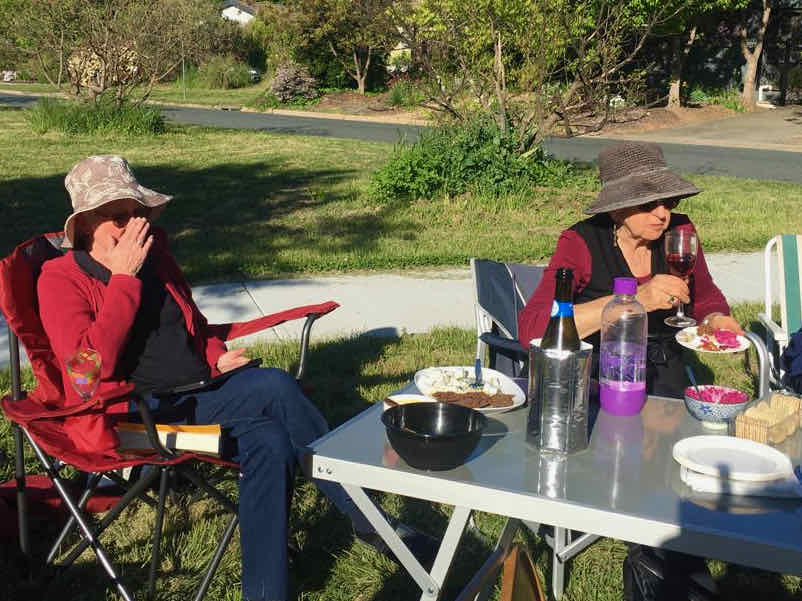
With pandemic post-lockdown restrictions still in place, but not wanting yet another Zoom meeting, Minervans "pivoted" (to use the word of the day) to a late afternoon meeting in the park opposite our October host's home.  We enjoyed our savoury nibbles, wine and cake in the late afternoon sun, while still keeping to our tried-and-true bookgroup formula - chat for half an hour or so, book discussion for around an hour, followed by cake and chat for another half hour or so. 

Our book was Sofie Laguna's Infinite splendours, which tells the story of Lawrence who was, as a sensitive, imaginative ten-year-old, groomed and raped by his visiting uncle. What happens to Lawrence after this, how he traverses life as a damaged person, occupies the major part of the book. It's a tough, heart-in-throat book about, as Laguna says, the price paid when certain boundaries are crossed.

We started of course, with our ...

First impressions


Several of our first impressions aligned, with the following reactions recurring most often:

  • a bit repetitive, so longer than necessary
  • a tough, painful, disturbing read, "a bit of an ordeal", particularly given we've already done novels about intergenerational First Nations trauma, and poverty and alcoholism, this year
  • powerfully, beautifully, superbly written, including the writing about the mountain, nature and the landscape
A few of us were uncertain about the credibility of Lawrence's reaction to his experience. The book could read that his reaction is inevitable whereas evidence points to the contrary. Some of us weren't completely convinced by Lawrence's trajectory, though we were able to go with it.

Other impressions included:
  • had faith that Laguna would leave us with hope, but this time it felt a bit thin
  • liked that it put a human face on a child molester, showing that underneath there is often a suffering person who is damaged, but overall found it too much of a social messaging novel, and felt lectured at
  • thought the art was boring and predictable 
  • thought the best parts were the children interacting at the beginning
  • didn't believe the character or resolution
  • was drawn in by the lovely depiction of childhood, really liked the use of the mountain to evoke Lawrence, and found it so sad, but was entranced
  • found the characters, even minor ones, very well described
  • found the fear, foreboding visceral at times

Further discussion

Naturally we focused a lot on what happened to Lawrence, how and why it happened, and how nothing was done for him after the event. We discussed the suggestion in the novel that his mother and uncle (Reggie) had been molested, and that Reggie told Lawrence not to tell his mother because it would destroy her. We also noted that Lawrence's mother had likened Lawrence to Reggie, describing them both as clever. One member wondered whether the mother had been molested by her brother (Reggie) when young, but the rest of us didn't see this. We noted that Paul had been less interested in Uncle from the start. After the event, he suspected something had happened, asking Lawrence "what did he do to you?", but the traumatised Lawrence refused to answer. This was heartbreaking, given he had done all he could to protect Paul from being abused similarly. All these and more affected why the situation played out the way it did.

We considered that one of the reasons Laguna set this novel in the past was that it was a time when there was less awareness of abuse and of its potential longterm impact. It enabled her to more authentically tell a story about someone who went under the radar.

We discussed the writing of the main abuse scene, and how it was described from a 10-year-old's perspective. We agreed that Laguna conveyed well what happened without using language that Lawrence wouldn't know.

We talked a lot about Lawrence, and his apparent naïvety as an adult. In many ways his development stopped when he was 10-years-old, which is not surprising. He changed from the sensitive, imaginative, curious little boy he had been to someone withdrawn, and prickly. He fluctuated between love and hate for his mother and Paul. 

We noted that Laguna quickly spans the years from 10 to 25, when the mother dies, and doesn't detail Lawrence's reaching puberty. Laguna uses various ideas to convey the effect of the trauma on Lawrence, one being his bowel-movement difficulty with visits to the outhouse being excruciating for him, and another being descriptions of his "two selves", which started at the time of the abuse: 

I felt myself dividing; there were two selves to choose from. One inside, one outside. (p. 152/3)

Much later, when the final crisis comes, Lawrence reflects

It was another moment on the way to the next, and I was both in it and outside of it. Yet was it not the same for all moments? One part engaged, another observing. Two selves. (p. 411)

One member suggested that, in some ways, 10-year-olds are the peak of human achievement. Expanding this, another member added that Lawrence reads in his art book that Constable had said he had seen all he needed to see for his paintings by the time he was 10 years old.
We discussed the ending a little, but got a bit waylaid by one member saying she didn't believe it at all. This resulted in a good discussion about art and artistic talent, and about Lawrence's skills and what style we thought he painted in, but we didn't discuss other aspects of the ending.

We also briefly discussed the large number of motifs in the novel: the bunker, Wallis (a mountain in the Grampians), the outhouse, the scarecrow, Robinson Crusoe, colours, Madame Butterfly, to name some. Were there too many? We all liked the role of Wallis, as something unchangeable/stable but also magnificent in Lawrence's life. We also felt that the bunker worked well as a place of safety for Lawrence, even if sometimes that safety meant hiding from himself rather than resolving his inner demons.

We talked about the title, which came from the artist Millet who said that "I see far more in the countryside than charm, I see infinite splendours." Lawrence spent his life trying to capture those splendours, and at the end his art, in a sense, achieves "eternity" (or "infinity") for him.
We talked also little about Paul. Some felt he'd been an excellent brother, while others felt he had been too cursory in his care. We liked Mrs Barry, who had recognised that Lawrence behaved like the men who had come home from the war (ie. traumatised) but, of course, she didn't know why.

Some members were concerned about some anachronisms (caused probably by editors being too young!):
  • Ten-year-old Lawrence would not say "f**k off" to his brother in 1953
  • The scarecrow's face was coloured with a marker which members felt didn't exist then (According to Wikipedia they were around, but would they have been prevalent in rural Victoria at the time?)
  • Reggie makes coffee which was not likely in a 1950s country home

A member referred us to other works on child abuse, Polish-Swiss psychologist Alice Miller's Thou shalt not be aware, and Andrew Bovell's play, When the rain stops falling.

No matter how much we liked or struggled with the book, we ended up having our usual highly engaged, wide-ranging and insightful discussion - but, we also agreed that we'd like to fit in a few lighter (though still meaty!) books next year!

And, some pics ... with thanks to the (absent) photographer


Present: 11 people

Thursday, 19 August 2021

Nardi Simpson, The song of the crocodile


July is our Indigenous book month and we chose the much acclaimed first novel by the singer and songwriter, Nardi Simpson, called Song of the crocodile. This novel has been shortlisted for 3 awards in early 2021 and Simpson won the black&write! Writing fellowship in 2018.

It tells the story of four generations of an Indigenous family living in the outskirts of the river town of Darnmoor in northern outback NSW. The town is linked to the Indigenous settlement of the Campground by the Old Black Road. This road of four miles has to be walked daily by the main characters in this novel. They are parallel settlements except that Darnmoor tries to deny the existence of the Indigenous workers living in poverty and injustice. This story tracks parts of the lives of three very strong and resilient women, Margaret, (Mili’s grandmother) Celie (or Ceil) (Mili’s mother) and Mili and her boys, Paddy and Yarri. The landscape of the area is all-pervasive in this novel.

First impressions:


  • Hard challenging read, as it tracks racism, injustice and black and white prejudice. However, listening to an interview with the author she has an uplifting take on her creation – she admires the entrepreneurship of the women and their ability to cope with such injustices as wage theft. Many features of the character’s lives were never fully explained but clearly suggested in the novel.
  • Hard to get into after just finishing Hilary Mantel’s The mirror and the light. Very tragic, but also shows strength and resilience which are positive features of the characters.
  • Liked the merging of the living and the dead.
  • EPIC and harrowing and impending things are going to happen. (We returned to ‘EPIC’ many times during the conversation).
  • Glossary would have been good. 
  • Irritating book, loved the characters but frustrated by certain features eg in the ending, the water didn’t travel over the levee (but others felt we are not told are not told whether it did or didn’t). Didn't like that all the good characters got killed or died eg Tom and Wil. Was Wil’s death because he consumed so much sugar ? Was Tom run over by a semi-trailer?
  • Can’t believe all white people are shits – thought that was overdone. Found it an extremely challenging novel and didn’t like the writing style. Felt bashed over the head by the same point and felt it needed a good edit. Even felt it alienating.
  • Really liked it and enjoyed it. Felt it was more a fable than a ‘real’ story. Gave a sense of what life is like for Indigenous people rather than reflecting exact reality. There were deaths like Wil and Yarri’s but there was also joy. For example, the communal life at the Campground before the levee broke up the community. There was so much sadness but also much love between the characters. Liked the interplay between the spirit world and the human world.
  • Found it engrossing, but the feeling of doom pervaded. Admired Celie setting up the laundry shed which was positive and the relationships with the other women workers. Reminded me of Pachinko and the relationships between those isolated Korean women living in Japan.
  • I am not into magic realism but I liked the spiritual world Simpson created. Her language and expression was wonderful. For example, when Mili was raped by the Mayor it wasn’t spelt out but inferred with metaphors. Also, there was one good Greek man – Angelou who helped Celie. (This was questionable according to another who felt he may have been ‘bothering’ the women.)
  • Is this book a bit like works by Isabelle Allende? Another member disputed that claim. The author does not like the term ‘magic realism’. 
  • Simpson comes from a very talented family of creative people and I am really glad I read it.
  • She is a supersmart woman who was not able to finish a formal education at school but is now doing further tertiary studies. 
  • The deaths were shocking but the author blended them into the cycle of the character’s lives. 
  • Strong resilient people who were not able to realise their potential. 
  • The book felt like a tribute to these people she has created even though they were apparently a mixture of people she has known. 
  • How do people keep going when struck by such adversity?
  • I don’t understand why people died – a bit romanticised.
  • The campground was community even though it was 4 miles out of town. Injustice upon injustice. 
  • I found it quite uplifting. I was expecting a dramatic climax – for example, a water spout or the war memorial monument rising up!
  • Fabulous book, ambitious and very rewarding – very different way of seeing the world.


Discussion


We began by discussing the main characters, Celie and Mili. We all felt very sad that they were unable to love Paddy who was the result of a rape of a very young and vulnerable Mili by the Mayor. As one reader said, Rape and its consequences are hard to make anything good out of. Mick Murphy knew that Mili was a treasure and some felt she was set up with the acquiescence of Vera, Mick’s wife. One member would have liked more about Vera and others felt sorry for her. Darnmoor was male-dominated and Mrs Murphy was definitely under the thumb of her husband.

One reader thought there might be a way of understanding the talk about Mili’s eyes – an unusual shade of green. The baby’s (Mili’s) eye colour changed when her father was killed by the truck. The idea had been that Tom would get a house for him and Celie and baby Mili. This also involved with the sad story of Mili’s friends, Trilpa and Eadie.

However, we decided that for us as white people it is hard to read and fully comprehend an Indigenous resolution to problems.

We thought Celie was a successful character who demanded a job from the Mayor’s wife and then worked very hard doing the town’s laundry. However, we couldn't be sure that they were receiving correct wages for the labour. We all admired Bess, Celie’s sister, who was not romanticised and who also worked very hard and sewed so beautifully.

Wil was a strong character who cared for his boys and Mili. He had threatened the mayor in order to obtain their promised house. This house, we felt, was a blessing but also a curse for Milie as it isolated her when she most needed friends and family.

For the family, life after the rape was very difficult. It was even harder after the birth of Paddy. Mili is unable to relate to her child. Her mother and aunt also retreat. Yarri loves his brother, in fact idolises him.

We all appreciated Celie's mother, Margaret Lightning, who like the others was at the coal face of prejudice. She worked so hard in the hospital but was then dismissed crudely. All these characters face prejudice each day.

Mick Murphy is proud of his grandfather and so he explained it to Mili. One reader found his interest in talking to her unbelievable.

Nardi Simpson is reflecting stories she has been told and her perspective on town folk arises from holidays she spent up near Walgett visiting friends and family. Her characters are an amalgam of various people and her imagination. This is an Indigenous story and we as white women can never fully comprehend the full ramifications of their difficulties.

Nardi is keen to share her language in the novel and did not provide a dictionary. She doesn’t want readers too worried about individual meanings but go with the flow.

An excellent interview with the author is by Daniel Browning from ABC Radio National. 

We discussed the language of the spirits, such as the crocodile. Is the crocodile only a negative spirit? He is part of the environment so it is not black and white (no pun intended).

It seems an evil spirit but it is nuanced – not in a Judeo-Christian way.

There is also the question of how to live as a good person – which is often posed by people at the end of their life.

There is a spiritual view of the world in this novel. The stories are not didactic but create ways to think. It was reminiscent of Greek tragedy for one of our members. In that, there are similar larger than life characters between the divine and human.

We thought there was some humour in the novel, which slightly eased the sense of tragedy. A good example was the funny scene in the laundry where Celie and Mili compare their hand done washing to the quality achieved by the new appliances. They do it by washing one handkerchief. Our member who grew up in South Africa said she remembered similar hesitancy by her mother’s staff when washing machines became available.

The style of the novel was not discussed widely, although one reader said she thought it was in the ‘middle’ of the recent novels by First Nations’ writers. We also thought that various other Indigenous writers didn’t like the term ‘magical realism’, as it doesn't properly reflect their spirituality, which is unique to Australia's First Nations peoples.

A member advised us of a south coast festival which may be on, depending on Covid in NSW, the October version of Giiyong Festival.


Present: 10 members

Wednesday, 30 June 2021

Steven Conte, The Tolstoy Estate


Our group's June book was Australian author Steven Conte's second novel, The Tolstoy Estate, which takes place over six weeks - November-December 1941 - of Germany's World War 2 campaign in Russia. The specific setting is a German medical unit that was based in Yasnaya Polyana, Tolstoy's estate, near Tula, south of Moscow. 

The novel is told through the perspective of German military doctor, Paul Bauer, who is based there with a medical unit led by Julius Metz. At the estate is the curator of the site, Katerina Trubetzkaya, who is, not surprisingly, hostile. A relationship develops between Paul and Katerina, but against a backdrop of deteriorating conditions both on the war-front and in the unit, as commanding officer Metz's behaviour becomes increasingly erratic.

The book has been shortlisted for the 2021 Walter Scott Prize for Historical Fiction, and longlisted for the 2021 Colin Roderick award.

We started of course with our ...

First impressions

  • Enjoyed it because of its setting in a German army hospital in Russia, its exploration of love (particularly of love in difficult times), its discussion of writing and literature with wry reflections on Conte’s own book, and its structure with its sudden change of tack partway through. 
  • Loved it, couldn't put it down, because of its details which suggested it was well-researched. The harrowing details felt convincing, and the ending didn't let me down. 
  • Loved it, though got tired of all the operations, so loved it when the first set of letters appeared, because this kept me going. Haven't read War and peace and felt it might have added some layers. Loved the description of the house. 
  • Really enjoyed it, found the historical context very interesting, including that Tolstoy was a pacifist, as this novel is. It's a little romanticised, but reality wasn't romanticised. Hitler and many in the army used drugs during war, which may have resulted in some madness or deluded behaviour. There were great characters in the medical team, some feeling real, others more "hyper-real".
  • All of the above. As with Overstory, this is a book I'd love to write an essay about to draw out all the paths. Enjoyed the themes about love and writing (such as its discussion of "the usual reasons one values a novel"). Thought the book was particularly about Katrina, and the many facets of her as a person. Was interested in the reference to the Kreutzer sonata
  • A bit "iffy" at the start but ended up enjoying the book; it won me over. 
  • Liked it but didn't love it. Thought A gentlemen in Moscow was a better novel (says the member who recommended this one!) The references to the use of drugs during war are real. The surgery scenes felt like they'd come straight out of a textbook. Thought the Caesarean scene by candlelight was a bit far-fetched but "it probably did happen sometimes". Made me want to read Tolstoy again. 
  • Enjoyed it, particularly all the different characters. Found it a gentle book, considering the topic. Liked the descriptions of the snow, trees, countryside. 
  • Really enjoyed it, though doesn't think it's a great book. 
  • Really enjoyed it too, found it a visceral read with the descriptions of the icy cold conditions on the dressing station, in particular. The surgery scenes were very real. Thought it a political story, about a good man in a bad army. Katerina, also, was a good person in a bad regime. 

Further discussion


We talked about the novel's exploration of the past and the future. Metz saw himself as a man of the future, a d criticised Bauer for wallowing in the past (in Tolstoy). In one of his letters, Bauer talks about old people wanting to "wallow in memory, when clearly the healthier thing to do was to stride into the future". However, it's a complicated issue as Bauer seems to realise. In his letters, he wants to pick up the past and stride into the future with Katerina.

We talked about Nazism's master race theory, which posited the German race as the heroes of the future. But, as one member said, Bauer's life on the front is immersed in the consequences of aiming for this future. The gay dentist/anaesthetist Hirsch is an example of Nazism's vision riding roughshod over individuals. 

Bauer, on the other hand, saw people as individuals. War and peace, he tells Katerina, restored his faith in

doing good in the world; because if, as Tolstoy argued, we are all specks in a vast world-historical drama, including those who think they’re in charge, it follows that everyone’s actions are potentially significant, that the humblest person can influence events as much as any general, emperor of tsar. (p. 218)
One member reminded us of Bauer's recognition of the future in Demchak, 

It was good to be reminded of the talents of the young, who in time would run the world and, one hoped, make a better fist of it than those who were currently in charge.

Ironically, though, the black-and-white Hiwi Demchak is perhaps not the best of the young to achieve this!

One member commented that war is ethically confronting, which we Australians are seeing played out now in the SAS Officer Ben Roberts-Smith court case.

We also talked about the links with War and peace re Napoleon's retreat from Moscow. As one member said, both Napoleon and Hitler's armies had confronted unseasonably cold winters.

We looked at some of the questions from Steven Conte's website

One question is, "Is Julius Metz a bad person? What about Hermann Molineux? Norbert Ritter? ‘Tout comprendre, c’est tout pardonner,’ goes a French proverb: to understand all is to forgive all. How true is this?"

We talked about Metz being mercurial, unreliable, and able to be "played" by Katerina. Bauer believed the drugs being given experimentally to Metz affected his mental ability. We talked about their being value in "understanding" bad behaviour but where is the line? At what point can you forgive? Also, how do you empower people to stand up for their own beliefs? One member noted that Metz was good at his job, and did save lives.

One person wondered whether Bauer is a somewhat idealised character? Some thought perhaps he was, while others thought that he falls within the range of "real" people. As a surgeon, Bauer didn't have to be involved in the politics, one member suggested, though others felt that being a doctor in the regime, he couldn't avoid it.  

Considering the discussion this question engendered, one member suggest that it was a sign of a good novelist that we could get so much into the skin of his characters.

SOME SPOILERS

Another question concerned the structure and plotting: "What did you think when the first letter was introduced into the narrative? Did it shock you? Did it change your mind about the novel or change the way you read it? Did it reduce the tension for you or increase it?" 

One member had already mentioned in her first impression that it kept her reading, as she had become worn down by the extended chapter on the surgeries. Another member commented that it told us that Bauer and Katerina had survived the war, and wondered why he had decided to tell us this? What did he want us to focus on if it wasn't that plot issue?

We discussed how Conte explores a relationship coping with the stress of competing regimes, and that it showed what a strong bond they'd formed. One member hadn't got the feeling that Katerina was "into" Paul (Bauer). However, as others said, the novel is told from his third person subjective point of view, so, until the letters, we only see the relationship from his point-of-view - and he is uncertain about her interest. Another noted that Katerina's reference to not ruining his looks in the frostbite scene suggested her attraction to him! 

A member complimented Conte on his insight into human feelings, finding particularly real Katerina's description of how she missed Paul.

The final question we considered was: "Siegfried Weidemann advises Bauer to ‘Focus on your own job. Don’t look left or right. Obey orders and let someone else fret about the rest.’ What do you think of this advice? In your family, your workplace, your locality or your nation, is it unethical, necessary or reckless to disregard politics?"

Being Canberrans, we immediately thought of the challenges currently faced by public servants whom we feel are not encourage to give "frank and fearless advice" but to follow party lines. We talked about other works which explore personal responsibility, including Bernard Schlink's The reader, and Christopher Hampton's play, A German life, about Brunhilde Pomsel who worked in Joseph Goebbels’ Propaganda Ministry. 

One member talked about the Government's being invested in creating heroes because we need people to go to war. Conte, we agreed, makes us think about making decisions. We can get caught up in the heroic stories. 

We liked that Conte has covered here a story that hasn't been told before - the 41 days of German occupation of Yasnaya Polyana. (Though, as one said, the book was inspired by Marie Curie's daughter, Eve Curie's Journey among warriors, 1943, which includes her description of a visit to Yasnaya Polyana, three weeks after its liberation from invading German forces.)

This was a book that engaged us all and generated a wonderful and wide-ranging conversation. A great choice, even if the person who recommended it didn't love it!

Present: 9 members

Wednesday, 28 April 2021

Best Australian Science Writing 2020

Back in 2016, our group went a bit left field and scheduled the 2015 edition of Best Australian Science Writing. We thoroughly enjoyed it and the discussion, and so decided it was time to do it again with the current edition. This one, Best Australian Science Writing 2020, was edited by Sara Phillips, and is the 10th Anniversary edition.

In a slight variation of our usual start where we go around the room giving our first impressions, we decided for this meeting, as we did for the 2015 edition, to start with each person naming a favourite or standout article, and describing why they'd chosen it.

This is how it went ...

Dyani Lewis' An identity crisis for the Australian dingo: the ecological importance of the dingo, the taxonomy issues involved, and the politicisation of science. This was a thread through the collection but is reflected here in how different taxonomic decisions can affect policy regarding the dingo (native or domestic?)

Ceridwen Dovey's True grit: an elderly scientist has his day, finally. Also liked the sense of human warmth in the story, and found the science itself regarding moon dust interesting

Jo Chandler's The Murray-Darling's dry mouth: the politicisation of science is saddening; also sad about the ongoing deterioration of the beautiful Coorong and its impact on the whole Murray-Darling system.

Peter Meredith's Underwater and underrated and Rebecca Giggs' Bovine friends forever: this member snuck in two favourites! Grew up around cows, and loved reading about something she'd seen and experienced.

Cameron Stewart's Brain wave and Konrad Marshall's Jeepers creepers: another member who snuck in two favourites. Loved the medical ones in general; was particularly interested in the brain research involved in "Brain wave" and the work of the woman driving the research described in the article.

Lesley Hughes' The milk of human genius: really liked Jo Chandler's Coorong one too, but that had been taken, so nominated "the milk one" because of the environmental issues and the research involved in finding alternatives.

Bianca Nogrady's Meet the families; Jen Martin's Listening to Antarctica and Jane Cadzow's Sixteen zoo staff. More than 200 animals. An encroaching fire. The rescue operation that became the pride of Mogo: Another cheeky member, this one nominating three! Each one spoke to topics or places of specific interest to her (taxonomy, Antarctica and Mogo Zoo).

Ricky French's The case of the missing frogs: really liked the evocative opening paragraph about a frog suddenly giving birth through its mouth, while it was in a cage on the passenger seat of the car a ranger was driving. This member had chosen Ceridwen Dovey's True grit, but it had been taken already, so French's article was her back-up choice! She really liked Dovey's writing.

Arwyn Stone's Not-so-smart technology: The science (or lack thereof) behind period and fertility trackers: she was impressed by the journalistic style, the science, and the fact that it dealt with apps. (This article won the Bragg Student Prize, and was added at the end of the book, after the after-matter.) 

This last member, as some did with the 2015 edition, read the book by following the links of like articles at the end of the article she was reading.

Then the free-for-all ...

We then talked about other articles we enjoyed, and some of the issues the volume raised for us:

Michelle Starr's The repeating signals from deep space are extremely unlikely to be aliens - here's why: partly because of what it says about scientific method.

Peter Doherty's Foreword: Science writing for normal and not-so-normal times and editor Sara Phillips' Introduction: Seeing the world with fresh eyes: enjoyed reading Doherty's perspective on COVID-19 (written very early in the pandemic), and liked the effortless way Phillips covered the volume's contents. One commented on Doherty's statement that "the reason that COVID-19 can be so bad is that it is both a respiratory infection and a blood clotting disorder", although a medical member of our group didn't fully agree that it was "a blood clotting disorder".


Andrew Wear's Gone with the wind: the description of how Denmark, over 40 years ago, started addressing the "energy" issue, and its ongoing innovative social, scientific and economic approach versus Scott Morrison's lack of vision (still). We particularly liked that Denmark has only two TV stations, both government, which means Danes trust the news. We did note that Denmark had been quick to stop AstraZeneca immunisation which seemed a paradoxically emotional rather than rational response.

COVID-19: We commented on the three articles on the pandemic - noting that the choice of articles for the edition had been made in March 2020, which was very early in the pandemic. Nonetheless, the three articles were illuminating: Felicity Nelson's What is pathogen sovereignty, Liam Mannix's The perfect virus - two gene tweaks that turned COVID-19 into a killer, and Tessa Charles' Synchotrons on the coronavirus frontline. Regarding pathogen sovereignty, we discussed the issue of sharing science with the world (which is also covered in Smriti Mallapaty's article on protists). One member was particularly interested in the synchrotron article. It filled in some holes in her understanding of things she'd read.

We talked about Wilson da Silva's The good earth and its message about improving mircodiversity in the city. One member was interested in the issue of animal ethics, and the view, as explored a little in Peter Meredith's Underwater and underrated, that animal "intelligence" provides arguments for treating them ethically. We agreed that the fact that they are living, regardless of human notions of "intelligence", should warrant ethical care and treatment of all creatures. One member then talked of her awareness of a stick of celery's "will to live" in her fridge!

In terms of the overall volume, we noted that most of the articles - probably not surprisingly - are about cutting edge developments, and also that the majority are written by science journalists rather than practising scientists. The journalists translate the science for lay readers, but they also tend to use a journalistic formula to do so - anecdote, explication of the science, conclusion. 

This led us to talk about research in general and the dire situation in Australian universities. We teased it out from personal, political and economic angles, the poor support, in particular, provided research and researchers. Universities have moved from a salary-based research system to a grant-based one. One academic in the group noted that you tend to have to "have the results" before you apply for the grant to prove the grant is worth being awarded! Smriti Mallapaty's article on protists, For risky research with great potential, dive deep, looks at other research, looks funding models, particularly for risky or longterm research.

We briefly discussed the early 20th century Australia father and son scientists and Nobel Laureates, William and Lawrence Bragg. They are too little known in Australia, but they are commemorated in the Bragg Science Writing Prize which is associated with this anthology. The 2020 winner was Ceridwen Dovey's True grit, and the runners up were Ricky French's Case of the missing frogs and Konrad Marshall's Jeepers creepers. Lesley Hughes' The milk of human genius, Donna Lu's Stranger things, and Nicky Phillips' Bringing home the ancestors, were the other shortlisted articles.

Finally, we talked about the two poems in the collection, Jenny Blackford's Black ice, frogmouth and Alicia Sometimes' Gravitational waves.

Present: 9

Monday, 30 November 2020

Melting Moments by Anna Goldsworthy


Opinions varied about this ‘domestic’ work of fiction from dissatisfaction to thoroughly enjoying it. Some of us thought there were hidden depths to the story while others just wanted more about the characters and less episodic moments.

Anna Goldsworthy is a concert pianist and teacher as well as an accomplished writer. Melting moments is her third published work, but her first novel. She is 46 and the daughter of well-known and much published writer and medical doctor Peter Goldsworthy. Adelaide is her home town and it is the major background to the story. 


The story begins in 1941 when Ruby travels to Sydney to reunite with her new husband Arthur, who has been in New Guinea. The story flows on from this point concentrating on Ruby and her mother and mother-in-law, her daughter Eva and her granddaughter Amy.  There are numerous short episodes or glimpses of her long marriage to Arthur and their relationship in the big house in a suburb of Adelaide. 


First impressions 

  • Partly enjoyed it but not a book I would recommend
  • Little vignettes were good to read
  • No literary overlay to it
  • Enjoyed reading about the roles of men and women from the forties onwards and especially the idea of the perfect housewife
  • Very funny in places and possibly ironic
  • Well written and quirky
  • Episodic which I found a bit prosaic, liked the setting of Adelaide
  • Found that Ruby’s life was similar to my Mum’s life – ie no career except in the home – and father’s dominance as breadwinner
  • Didn’t hear much of Ruby’s interior life, worried that Ruby and Arthur didn’t know each other even after many years of co-habitation
  • Issue of the returned soldier and their common refusal to talk about their war experiences and how that changed them irrevocably and the subsequent effect upon their marriages, especially if wed before going off to war. They came back different people. (Later in our discussion we were surprised that Ruby did not want to hear about Arthur’s experiences when he finally wanted to tell her.) 
  • I was annoyed that there was not more detail about Arthur’s war in New Guinea (but others argued that that was not the point of the book)
  • Not well written because too much repetition
  • Frustrating and dissatisfying novel
  • Would have liked more about music – had no idea the author is a concert pianist
  • Read it twice and loved it
  • The author was exploring the path of many women in Australia and how their lives changed by the influences of 1960s/1970s Feminism – working outside the home after many years and possibly enjoying another romantic relationship?
  • Melting momentst itle is good because that is what the book captures – pinpointing aspects of Ruby’s life which explains the episodic structure
  • Gentle pace and would have liked more about the relationship between Ruby and Arthur 

Discussion


It has been suggested that this work is a little like works by Jane Austen but we didn’t agree. It is a study of women and their threads through life. (Some of the story is based on Goldsworthy’s Grandmother’s life.) It only has a little satire. Some of the characters are a little stereotypical such as Arthur’s mother, the rather sad Granny Jenkins, but some of us liked the contrast with Ruby’s Mother who seems so normal. 


Ruby’s affair after Arthur’s death was much discussed. We liked the fact that Eva, Ruby’s daughter, told her that she had done her duty as far as Arthur was concerned and it was fine to have another relationship. We wondered where the character of Eva, a baby boomer, came from as she seemed so different from Ruby and the other older women. (Maybe Goldsworthy was inspired to highlight the difference from the older generation). We calculated that Ruby was born about 1919 or 1920 when a few of our mothers were also born, which was considered the Great Generation (1901-1927). The next generation was called the Silent Generation (born between 1928-1945). 


We spent considerable time discussing Arthur and his characteristics. He was supportive of his daughter getting an education to become a doctor and showed that he was quietly wise.  We admired the fact that he allowed his wife Ruby to take her mother on a holiday to Mildura quite a few times. There were also echoes of family life experienced by us or by our relatives eg hasty marriages before heading off to the war. This was often done by couples as the man felt that if he didn’t come back the woman had an income from a war widow’s pension. Arthur even mentions this reason. Arthur also was tolerant of having two mothers living with them which must have been hard for both of them. Arthur’s book on sex, (caused much hilarity), which he and Ruby enjoyed for a while at least. 


This is a very suburban novel. The suburb Glenside, where Ruby lived had an asylum so it was tainted by that institution for many Adelaide people. Ruby and Arthur had a pleasant home there, and she obviously loved it. She made choices and had a husband who allowed her to garden and work around the home. She even worked out of the home, later in life. In comparison, she was angry with her father who treated her mother badly, until her Mother finally left him on the farm and moved to Adelaide to live with Ruby and the family in the big house. Her father was a charmer but not reliable. 


Ruby could have had an affair when she was still young but the opportunity disappeared and she was often wistful about what might have been! Ruby lead an ordinary life, not one filled with drama. Things might have happened but did not. 


We were sad that there was not more about Ruby’s son who seemed to just fade away in the story. 


Three current shows were mentioned which are related to some of the issues raised in this novel :


Mum:  a comedy on television which one member likes

Women of steel: a very good documentary about migrant women in Wollongong in 1980 who took BHP to court over discrimination by not allowing them to work in the steel industry.

Brazen Hussies: a documentary film which is on at the Palace Cinema until Wednesday.  

It is about the Women’s movement between 1968-1975 and the issue of choice for women with what they do with their lives.

Wednesday, 28 October 2020

Julia Baird's Phosphorescence: On awe, wonder & things that sustain you when the world goes dark


We are having bumper meetings these days, because due to COVID-19 we retirees are not travelling the way we usually do through the cooler months. It's lovely actually, though with 10 or more at meetings, the enthusiastic discussions can be hard to follow! I apologise to members whose ideas I've missed, in other words.

This month's book was by Aussie journalist and biographer, Julia Baird, who has had a very tough cancer journey over the last few years. Her book, Phosphorescence: On awe, wonder & things that sustain you when the world goes dark, ostensibly contains the lessons she has learnt to help herself and others through such times. Some of the essays were written (in some form) before her illness, which suggests that these ideas have been swilling around her head for a longer time.

As usual, we started with ...

First impressions


We basically broke into two camps, those who loved the book, and those who liked it but with reservations.

Those who loved it found the writing wonderful, commenting on the way she draws the reader in by observation and experience, and on the personalised, moving way she shared her ideas. They liked the way she drew different threads together. One listened to Julia Baird, herself, reading it on Audible, and found it excellent, so much so that it made her want to buy a print copy to refer back to.

Those with reservations all liked much of the content, and didn't disagree in any major way with what she had to say. Like those who loved it, they found her a bright, intelligent woman, and thought her writing excellent. The reservations varied a little but boiled down to feeling that the book:

  • contained many ideas we could relate to, but offered nothing new;
  • felt disjointed, or as some said, the "phosphorescence" theme didn't play through the book as clearly as was expected;
  • was tedious at the beginning, but liked it more when it became apparent that it was a book of essays; and/or
  • felt a bit glib, and repetitive, which made it somewhat unsatisfying.

The discussion


The discussion, just like some felt the book was, was somewhat disjointed!

Members identified aspects of the book that particularly struck them, which included (excuse the lazy dotpointing!):
  • Baird's looking for nurturing experience from the natural world
  • much of the language and her descriptions 
  • the memoir aspects
  • her encounters with a wide range of interesting people, which we felt was partly due to her journalist career bringing her into contact with such a variety of people (like the millionaire financier in New York)
  • the way she seizes the day
  • the book's beautiful cover
We also talked a little about Baird's discussion of faith and doubt. One admired her being one of those women of faith who can relate to/reach a broad audience. We shared a couple of her comments about doubt:

The mark of a civilised woman, too, is to doubt the wisdom received from men for so long...

Another that several of us liked came during her discussion about its being ok to doubt scientists, who, themselves, recognise that things can change and that they need to "embrace doubt, and see shades of grey...". She says scientists have been wrong in the past "as have politicians, teachers, priests, principals, CEOs and all sorts of authority figures". And then, she adds in parentheses:

(Although, seriously, if you can't accept what the vast majority of scientists have to say about climate change, it's not doubt that is your problem.)

We all loved that.

We talked about the various references to Japanese aesthetics and philosophy. The prevalence of Japanese thought was interesting given she talks about visiting various places, but not Japan. The ideas, which are hard to express in Western words, are Shinrin-yoku (or forest-bathing, about the physiological/psychological benefits of being in the forest); Yūgen (about grace and mysterious experiences that are hard to explain); Wabi sabi (about imperfect or transient beauty); Kintsugi/Kintsukuroi (about repairing broken pottery in ways that the repair can be seen, making the damage part of its history and beauty); and Moai (about the groups created among newborns in Okinawa which provide social support through life).
Moai was discussed in the section on friendship which is beautifully called "We are walking each other home" (Ram Dass). One member loved the concept introduced in this section of Freudenfreude, which is a term coined, Baird says, by psychologists to describe the opposite of Schadenfreude

Another wonderfully named section that we discussed a little is "We are all wiggly" where she talks about accepting and/or embracing failure and imperfection. She describes her own spectacular failure as an activist for the ordination of women in Sydney's Anglican church. She argues that we should appreciate and recognise failed activist action, that we should honour the effort and the commitment. We should also recognise that quite often the issue keeps building and is eventually achieved. 

We also enjoyed her discussion in this section of the pressure on women's appearance - their dress, their hair, etc. We loved that the term "mutton dressed as lamb" was initially positively intended. (Oh, and most of us were surprised to hear that she has a big nose! We hadn't noticed!)

We laughed at some of the stories, such as her son's delightful hoarding of his underpants for the memories they are associated with, and her sock-chewing groodle, Charlie. Other stories that interested us included the story of hope as exemplified by Jim Stockdale who spent over 7 years in Vietnam's most notorious and brutal POW prison, and the subsequent concept of "The Stockdale Paradox".

Some of the other messages we took away included living life deliberately (by paying attention), the (counterintuitive) idea that the clue to happiness is to have low expectations, the value of awe (including "the overview effect"), and the importance of searching for our "ert" (a term coined by marine biologist Lisa-Ann Gershwin to oppose "inertia").

One commented, gratefully (ha!), that Baird didn't talk about the current "in" idea that she's hearing everywhere, gratitude!

The book provoked much thought among many of us about our own lives and values, but what was shared in the room will stay in the room. Let's just say that in the end we decided that, whether we agreed that the work was fully coherent or not, it was a book in which Baird was able to share many of the things she wanted to say and pass on, and that the book can work as "a salve for the weary".

Present: 11 members

Wednesday, 26 August 2020

Griffith Review 68, Getting on

Our August book, issue no 68 of the literary journal, Griffith Review, was a departure from our usual fare, and yet, although only a third of us read it all, its selection was unanimously approved. Why? Because this issue's topic, Getting on, or aging, was right up our alley. We started, of course, with our ...

First impressions

  • Enjoyed it, albeit was sometimes confronting, sometimes heartwarming, a sometimes a bit over the head.
  • Also enjoyed it overall, and also found it confronting in places. Liked that it opened with Garner, and enjoyed some of the poems.
  • Liked that it offered much to think about .
  • Thought that Sarah Holland-Batt's essay "Magical thinking and the aged-care crisis" set the scene well. Was interested in topics like the failure of the health care system, genetics and the definition of ageing. Enjoyed learning new information. Some pieces were very moving, but not all were specifically about ageing. 
  • Loved it all. Every piece had something intellectually interesting to offer about "getting on"; enjoyed the less scientific ones most. 
  • Read most of it but found some too depressing and others too scientific. Liked the Vicki Laveau-Harvie piece, having heard her at the Canberra Writers Festival.
  • Felt it was apposite for us to read, but found it a challenge. However, liked that it challenges our thinking about what sort of aged care we'd like, and thought it offered much food for thought.
  • Read all but last piece, and found it very profound, very moving, overall. So many good articles. Was particularly interested in the Mark Aarons piece about his long road to diagnosis, and could empathise, from her own experience of being an intern, with Melanie Cheng. 
  • Is a Griffith Review subscriber. Found the Garner opening piece a bit mystifying until she got to the end. Enjoyed Kathy Marks "A life in books" and Caroline Baum's "The hungry years". Was interested that many of the pieces were from people in the 60s, with nothing really from 80-somethings to provide an aged perspective. 
  • Read it all and really liked it. Particularly liked Sarah Holland-Batt and Beth Mohle's essays on the aged care system. Amused that one of the unrealistic fantasies described by Holland-Batt - "a geriatric co-op" style plan - was proposed by Burkitt for Gen Xers!

Favourites


Some of us nominated our favourites. One really liked Ailsa Piper's "Old Growth", because Piper is happy to admit to being old, saying "I like saying I'm old!" Our member sees so many people being "in denial". Other favourites included Sarah Holland-Batt's "Magical thinking and the aged care crisis" (3), Kathy Marks' "A life in books" (2) and Beth Mohle's "System failure". Honourable mentions included Helen Garner's "The invisible arrow" and Frank Brennan's "Contemporary loss". One member named Glenn A Albrecht's "One hundred years of sumbiotude"the most obscure article. 

Specific "stories" that individual members liked included that about the grand-daughter who was surprised by how forward-thinking her grandmother was, and the one (in Frank Brennan, "Contemporary loss") about the dying man whose family brought in his paintings to hang on the wall which resulted in conversations that helped personalise relationships between patient, family and staff.

Discussion


With such a diverse set of essays/memoirs/reports/fiction/poems, it was hard to have a coherent discussion, so this report will be a bit "scatty" ...

Of course we talked mostly about aged care in general, referencing in particular Holland-Batt and Mohle for their excellent analyses of the current situation, including how we got here, and for their thoughts about where to next. One member particularly liked Mohle's discussion of the new role of Nurse Navigator that's been created in Queensland and which seen significant reductions in Emergency presentations and overall hospitalisation. Both authors decried the Aged Care Act (1997) which contains no standards, no requirements for transparency or accountability.

We discussed the fact that some articles, such as Jane R Goodall's, discussed the idea of developing the role of "elders" and what this might mean. A couple of us liked Goodall's statement that:

The call of the elders is not to dwell on the past, but to renew awareness of our roots in it, and our place in a longer time scheme.
We also talked a little, though not in great depth, about euthanasia and assisted dying. We liked Blatt's idea of "magical thinking", such as the idea some people have that they will be in a position to take themselves out. We also noted the discussion in Andrew Stafford's "Dying wish" regarding the fine line between euthanasia/assisted dying and palliative care.

Dementia naturally came up a few times during the discussion. Several were interested in the articles which described the different types of dementia. We all felt that dementia would make a big difference to the experience of aging and the sort of care we might need or accept. All bets could be off in terms of our self-determination!

Other takeaways (or things learned) from the book, included:
  • Mohle's extortion not to catastrophise old age.
  • The idea that being young is positive and being old negative.
  • Charlotte Wood's finding that you die as you live: if you are angry or grumpy during your life you are likely to be like that in your final years. We laughed at her concern about when you should reset your default position!
  • The problems of food and eating in old age due to swallowing problems.
In terms of our own feelings about aging, we were generally positive. We felt overall that that there are big advantages to being an older person, that when you are old you can speak your mind more. Most of us seem to enjoy being old, appreciating the opportunity it offers us to express our ideas, the increased time we have to follow our passions. We noted, concurring with Holland-Batt, that our generation is more focused on self-determination versus previous generations which tended to accept authority and do what they were told.

Of course, we shared our various experiences of the aged care system, mostly through our parents. A couple commented that what they looked like loss of agency, from their point of view, wasn't how their parent felt. In other words, it's hard to know how we will feel, how we will perceive the world when we are much older and more frail. One talked about how her mother, who had dementia, initially ended up in a psychiatric facility rather than an aged care one. Another remembered her father's comment that growing old involves having to accept loss, which is expressed in Piper's article as ageing being a continual process of letting go. 

There was some discussion about the volume overall. One commented on the order of the pieces, how it started with 77-year-old established author Helen Garner, and closed with a 70-something debut author, Vicki Laveau-Harvie. She also liked the segues, or links, between the pieces. Another commented that the voices contained in the volume were primarily middle-aged or 60-somethings, and that there were no real aged voices. (We admitted, though, that not too long ago people in their 60s were seen as aged). It sent her back to a book published in 1979, Ellen Newton's This bed my centre, which chronicles the experiences of a 70-something woman with angina who spent 6 years in a nursing home.

Other works/activities we were reminded of, included:
  • Lisa Genova's Still Alice (book/movie)
  • Kate Grenville's One life: My mother's story
  • Ellen Newton's This bed my centre (mentioned above)
  • Webinars being run by Dementia Australia
In conclusion we agreed that it's hard to see how current trends in aged care will pan out given the significant aging of the population. We noted the lessons, that we all know already, such as that exercise, social interaction and good diet are factors that can help us have a good old age. Returning, as we often did during the discussion, to Sarah Holland-Batt we considered her comment that current aged care practice demonstrates a failure of imagination. We'd love to see more imagination - such as along the lines presented by writers like Mohle and Burkitt - applied to the problem. We wondered what impact COVID might have on policies and practices in the future. Will the return to being more people and community-focused that we are currently experiencing carry through to all sorts of people-related policies.  

Finally, one member said she loved the ending of Helen Garner's piece "The invisible arrow". Faced with the idea that his grandmother might stop writing, Garner's grandson said he wouldn't like her to do that.

"Why not?"
"Because," butts in his twelve-year-old brother, bouncing his football in a forceful rhythm, "it shows we exist"
Noice!

Present: 10 members

Saturday, 1 August 2020

Chris Flynn's Mammoth

For the second COVID month in a row, we were able to meet in person - appropriately socially distanced of course. How nice it was - and now full it was. With none of us able to travel, our usual depleted winter turnout was again not in evidence!

Our chosen book was the recently published novel, Mammoth, by Irish-born Australian writer, Chris Flynn. It's a surprising novel, narrated by a mammoth fossil, telling his story to a bunch of other, mostly incomplete, fossils, as they await going on sale at an auction. As usual, we started with our First impressions.

First impressions


While no-one disliked the book, our first impressions fell into two camps, those who loved or really liked it, and those who enjoyed it but didn't love it.

Those who loved, or really liked it, said:
  • Loved it, quirky, humorous. 
  • Enjoyed it, comic.
  • Ripping yarn, great imagination. 
  • Very interesting read, loved being reminded of her knowledge of old/prehistoric history; found the encounters between ancient and modern civilisation interesting; felt the novel was too short to get sick of it; and liked the ending.
  • Didn't like beginning, because the humour felt too corny but grew to like it; liked how it looked at human brutality; loved his commentary on writing (including such issues as veracity and believability, tone) and loved Mammut's statement that "No story’s gold from beginning to end", suggesting that this is the novelist fending off in advance criticisms of the boring parts of his novel.
  • Enjoyed the book, an easy read and an interesting diversion in COVID-infested Melbourne (emailed in.)
Those who liked it, but were more luke-warm, said:
  • Enjoyed it, but the banter was too disneyesque, and the narrative was confusing. 
  • Started with a bang, but got sick of it at the end.
  • Enjoyed the start, but got tired as it progressed, some of it was intriguing, but other parts were laboured.
  • Found it a clever concept, but got tired of the banter; however did enjoy Googling some of the historical information; felt Mammut went on a bit and didn't like T. bataar’s contemporary voice. 
  • Strange, cartoonesque, fragmentary 

Subsequent discussion

Our discussion was rather fragmentary, a bit like some found the book was! It was interrupted by a lively discussion about Blue Cornflower Corningware, which one member had discovered now has vintage status. It was a case of ancient Corningware facing off against ancient fossils!

In terms of the writing, we all agreed that the two epilogues were wonderful, and we also liked the book's opening with Thomas Jefferson's letter. In terms of criticism, besides the style of humour, various members felt there were some unnecessary digressions and some over-explication (such as in the Cuvier section.) 

A member commented that the novel felt like an Irish tale, and noted Palaeo's comment that

"this tale of the Irish siblings is damn fine storytelling. I'm pretty confident none of it is true, but, hey, I'm past that now" (p. 206)

She commented that this reflects the old idea of never letting the facts get in the way of a good story, but, she said, Flynn did weave a story around facts. 

Another member commented that the idea of collecting "memories", of exploring the idea "if these bones could talk", was inspired. And one proffered that Flynn was brave to write about America the way he does.

Of course, we discussed his exploration of environmental degradation, species extinction, and climate change. Some felt it was hard to believe that some of the ideas are true, such as the impact of mammoths (and their stamping on the ground) on climate change. However, others pointed to research, such as this and an Economist article shared by a member, which gives the idea some credence. One member shared the mammoth's comment early in the novel:

“Our world was changing and there was nothing we could do about it.” (p. 44)

She suggested this helplessness is exactly how our animals and land would be "feeling" today. 

We couldn't help turning to Australia, with one member noting the impact of introduced hooved animals on the Australian environment. We also discussed recent forecasts that the koala could be extinct in under 50 years. And what are we doing about it, one member asked? Still allowing development to continue in a rare koala habitat area! Unbelievable!

We also noted the reference in the novel to people in the 19th century not believing scientists, such as Cuvier's theory of extinction, just as there are people now who don't believe climate scientists. 

One member quoted the statement made late in the book - “Relentless growth is not sustainable” (p. 252) - and asked how do we find the balance between destructive "relentless growth" and human desire to imagine, create, improve? 

We talked about other contemporary concerns Flynn weaves in through the story, such as racism, speciesism, and the idea of history being in the hands of the survivors.

Related to this is another of the novel's concerns - trophy mentality, or, the idea of self-aggrandisement through big animals. This idea is introduced in the novel's opening - Thomas Jefferson's letter enquiring about the availability of mammoth bones. The fossils talk about the equation of large animals with men and power. Pterodactyl tells the group of being using in Hitler Youth training: 

We were presented to the eager teens as proof that Germany had once been the centre of might in Europe and the origin point for life on earth. Your mastodon friend in particular was elevated as a symbol of strength … I was referred to as the Reptilian Eagle, an apex predator who dominated the skies. It would have been a compliment, had it not come from the mouths of maniacs. (p. 159/160)

The novel was, in fact, inspired by a 2007 auction in Manhattan of fossils - those represented in the novel - that Flynn had read about. One of the novel's two epilogues chronicles some of the outcomes of that auction, at which celebrities like Nicolas Cage and Leonardo Di Caprio vied for big fossils! As Pterodactyl continued from the above:

Yet again the hominid males appropriate motifs of power from the natural world in order to make themselves seem strong. (p. 160)

The novel also provides a potted view of human history through selected - fragmented as some in the group thought - events. The focus, in particular, was human brutality, which is something Flynn himself has seen in Ireland. He has had guns pointed at him, and he has heard nightmarish stories, he has said. In the novel, he chooses historical events/times like British suppression of Irish rebels, the Nazis, the decimation of Native Americans to make his point about the way humans behave and treat others, about their relationship to power.

The novel also represents are rather fun roll call of some of the 19th century's top palaeontologists and naturalists. Many of us enjoyed reading about them, and researching them in Wikipedia and elsewhere.

In the end, this book that garnered mixed responses generated quite a wide-ranging discussion.

Present: 10 members

Sunday, 7 June 2020

There was still love by Favel Parrett

This book is short and sharp about life for people living behind the Iron curtain and being a migrant in an Anglo-Saxon dominated Australia. It is largely the story of 2 families, one living in Prague and one in Melbourne. They are related by their grandmothers being not only sisters but also twins. The perspective is from the grandchildren’s point of view. Ludek is the little boy living in Prague with his Babi. Life is hard for Babi and her grandson but also for the population of Prague. Ludek’s Australian great aunt (Mana) and uncle (Vilem) visit from Melbourne and tell him about Mala Liska who recounts the Australian part of the story. Ludek is intrigued why Aunty Mana left Prague and travelled to Australia. 

It’s a story in dated sections beginning in Melbourne 1980, Prague 1980, Prague in March 1968, Melbourne 1980,  Prague 1942, Prague 1980, Melbourne 1980, Prague 1938, Prague 1980 and Prague 1978, Prague 1981 and Melbourne 1981 and then Prague 1921.  We learn a little of Czech history with the invasion in 1968 by the Russians and we hear of the racism experienced by migrants in Australia and the general difficulties of working and living in a country with a different culture and language.

First impressions:


  • Enjoyable, tender, good hearted, perspective from children’s point of view is painful and unusual, structure is good
  • Very little happens but there is a lot going on
  • Delightful, almost not there, such fleeting stories, tricky working it all out, the grandma connection is intriguing, thought it might come to more than it does, not totally satisfied and not totally successful
  • Loved it, poignant, intimate, first person dialogue and perspective
  • Similarities between the children although they live on opposite sides of the world
  • Beautifully written, just gorgeous, slow read which fits in with our current Covid-19 sate of lockdown, gentle
  • Tale of loss for the people and country and with such a light touch for the story and the characters 
  • Enjoyed children’s perspective, enjoyed the author interview with Richard Fidler (see Radio national— Conversations)
  • Poignant, deeply personal
  • Sad, quiet, tale of leaving people and places behind
  • Excited to read it as a 2nd generation migrant from Eastern Europe with knowledge of Prague and Czechoslovakia, a bit dissatisfied too as the story was a bit too spare, would have liked more. Could relate to gherkins (best in the world) and apricot dumplings (love them). Could have been a bit warmer.
  • Was I reading a whole book or just essays stretched out? I read the review published 2 years ago about a 6-year-old going up stairs. Also expected the people to be Jewish as people I knew in Melbourne who lived similar lives were Jewish. (Supposedly lives of migrants not able to re-establish themselves to the way they were in their home country. ) 
  • It also expanded my view of Melbourne from my memories of my childhood.

Ensuing discussion:

LOVE


Why is it called : There was still love ?
‘Still’ has 2 meanings – the stillness and the continuity ? The Magician says:

‘I put the broken in my suitcase and take them with me until they are ready to go home again.
There is still love’ (page 181).

It is an ambiguous phrase – so much loss. There is a sense that the two children are greatly loved although dislocated from their parents. Their grandparents are stepping up. This causes the lives of the grandparents to be constrained. The children look back fondly on their growing years with their grandparents and it makes it all so poignant.

For instance, near the end there is a scene where Ludek has left his grandmother and is living in the country with his Mother and his new family and he misses the dirty city and his Babi. 

‘But sometimes Ludek missed the flat on the third floor, just him and Babi, no one else. He missed his city, where he ran and ran the old streets and was invisible.’  (page 185-6)

We would have liked more detail about the girl’s background which is not explained or told to the reader. Maybe this is what Favel Parrett is trying to say that we cannot know everything or it is too hard to tell.

Ludek’s Mother almost defects from the theatre troupe in Australia but she cannot because she loves her little boy, Ludek still in Prague.  The scene is portrayed through the eyes of the little girl who meets Ludek’s Mother, Alena. 

‘I’m going to try to stay here’ Alena tells Mala Liska (page 84) but it proves too difficult.

Mala Liska’s grandpa says to her 

"...they only let her come on tour because her son stays there, her mother stays there, her brother….It’s very complicated.” (page 85)

This brings up the idea of choice in life – we take it for granted in the west but many people do not and cannot take it for granted, especially pre 1989 in Eastern Europe.

HOME


This is a common theme throughout – quest for home – poignantly in the scene of Eva (Babi) walking home during the invasion in August 1968 

‘The Soviet flags fly. The huge guns point ahead.
“you should get home”. A voice behind her – soft.  A man, bright eyes burning.

“Those bastards!” he says. He is young, maybe a student.  She is old. She cannot do this again. She cannot fight anymore… “You should get home” he says again. … she must get home. (page 133-4)

That links up with Eva in the supermarket in Melbourne when she gets overwhelmed by the choice of products. We can all relate to this feeling. It is alienating. 

Another angle on ‘home’ comes from Vilem in 1942 in Australia. Here he has to call himself Bill to not incur a racial slur.

‘The only way to live now is to keep moving forward and not look back. It is the only way his heart can keep on beating and not break. He must look forward and not behind.
He must never look behind.’ (page 103)

This is the refugees ‘lot’ according to one of our members. 

Another reader talked about the film Goodbye Lenin which was shown in 2003 and is set in communist East Germany in 1989.

There was much nostalgia for the old ways in Eastern Europe. But we were reminded by this same member that those regimes were not benign, but punished their people and the effects have been passed down the generations. There are also a couple of scenes of people being watched to convey the surveillance of authoritarian regimes. Spies in other words travelling and keeping watch on the theatre troupe, for instance.

The book also explores the history of Czechoslovakia. Mention is made of the Munich Agreement before the Second World War and the feeling that the West would not rescue the people of Eastern Europe including the callous drawing of borders done by the allies.  ‘This was a huge scar on the soul of the Czech nation’. This is a quote from our member who has considerable knowledge and love of this country.

Ludek loves his city and the people. He is very kind to Mrs Blaza, the old lady downstairs.  She is all crumpled in her chair. And he discovers that she has died and asks himself where is her family. 

‘The city was full of old women left behind, left to keep everything going – to carry the old goddam world by themselves.’ (page 167) (Atlas metaphor.)

The statue of Atlas is an important feature of the city that he loves. He has trouble finding it then one day he comes across it:

 (Ludek) ‘wanted to tell Atlas how he had tried so hard to find him….’ (page 121).  

This leads him to think about his Mother so far away from home in Australia. 

There is the fun scene of Ludek and his grandma riding the sled which was a bit fantastical. But she came alive for Ludek and they enjoyed each other’s company. (Pages 171-179) But it was an important scene too because they talked about missing those they loved and not living with them – Babi’s sister (Mana) and Ludek’s Mother. 

‘Ludek put his head against her strong frame and hugged her back. And he didn’t care who saw him. His babi.’ (page 179) 

 There is also the scene of him pulling out the old tape recorder and playing the Rolling Stones music so that his grandma could dance. 

The characters have a complicated vision of home and the changes which occur over time.

GRANDMOTHERS


There is the sense that the grandmothers kept the family secure and together which they do in many societies, (such as African and Indigenous ones). They also keep culture going and keep raising the next generation.  

The book is a tribute to grandmothers and their strength. The statue of Atlas is a good metaphor for the grandmothers. 

PRAGUE


1980 in Prague has been largely forgotten about ,including by us in Australia, and how traumatic life was for the population and this book reminds us. Life was very different for them from us in Australia and it was not so long ago. It forced people to look inward and not trust strangers. Czechs tried to feel free away from the city so many acquired summer cottages in the countryside. That was the only place they felt liberated. Our member who knows this part of the world visited Prague in 1981 and found it a grey place where people avoided looking at you and there were no greetings. She also told us you could be imprisoned for leaving flowers at the John Lennon wall and he was singing about peace. However, once the Berlin Wall came down colour was restored to the city and the sun shone and there were flowers.   

Bill was a good character – quite gorgeous. He missed the theatre. It is ‘home’. We talked about his meeting with Mana. We also talked about his feeling that you must keep moving and not look back. But he is sad about their lives in Australia. He wishes it was better than it proved to be. This is particularly so when they are new to Melbourne in 1942 and they have to work on integrating into the new society. Language is a big barrier but they both work hard at it. (pages 102-103)

The Black Light Theatre of Prague is largely unknown to this group of Australians sadly, except for our member who has connections with this part of the world. The Magician is still alive and was the manager of the troupe, someone noted..  

European men in Melbourne eating cake were part of the texture of life growing up there in the 1960s and 1970s. Migrants brought their habits and managed to find little enclaves where they could get together. There was nostalgia for home. Sometimes thought migrants went back to heir home country but found it had moved on. It is a complicated vision of home.

We also discussed the gymnastics that was so popular in the 1960s. Mass displays especially of ribbon gymnastics. Triumph of the gods! We all remember marching at school.

STYLE


A member said ‘I liked the use of the suitcase motif. I loved how tight it was. Not a wasted word and how Parrett made one scene convey the bigger picture, like the scene in the shop when Mana is called a “stupid wog” (to convey racism) and the couple of scenes where the characters are being watched by spies.

Lots of short sentences and sentences with punch or a plea. For example, on page 119 

‘Ludek put his head in his hands.
Please call.’   

We felt that this book is also wispy. We were all trying to understand the story – and the suitcase is the main link throughout the book from the opening page. A book about migration and home and love. 

‘You must close up tight, protect your most needed possessions … your heart, your mind, your soul. You must become a little suitcase and try not to think about home’.  (page vii)

One reader felt that Parrett is trying to craft the story out of the little she knows about the personal histories of her family.  

This was another book club meeting via zoom which seems to be getting easier for us but still not nearly as good as meeting in person.

Members present : 12